
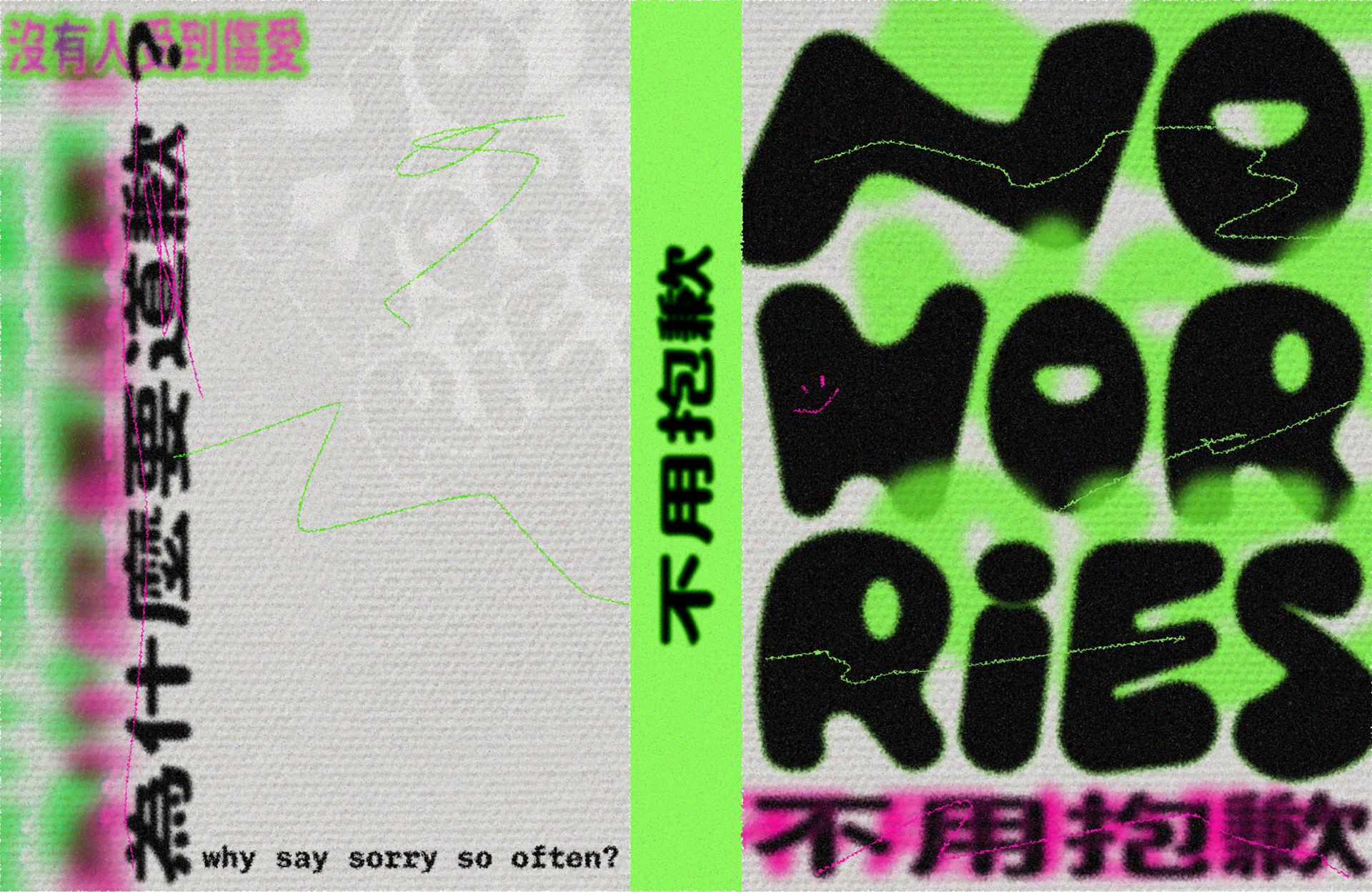
No Worries
不用抱歉
An imaginary book design.
A reflection on compulsive apologizing, inspired by conversations with my Taiwanese friends.
Some graphic design work in Figma and Photoshop, plus AI-generated text. Just for fun.
Some graphic design work in Figma and Photoshop, plus AI-generated text. Just for fun.
Compulsive Apologizing: A pattern of apology detached from actual transgression, in which the subject apologizes for presence itself, expressiveness itself, and difference itself.

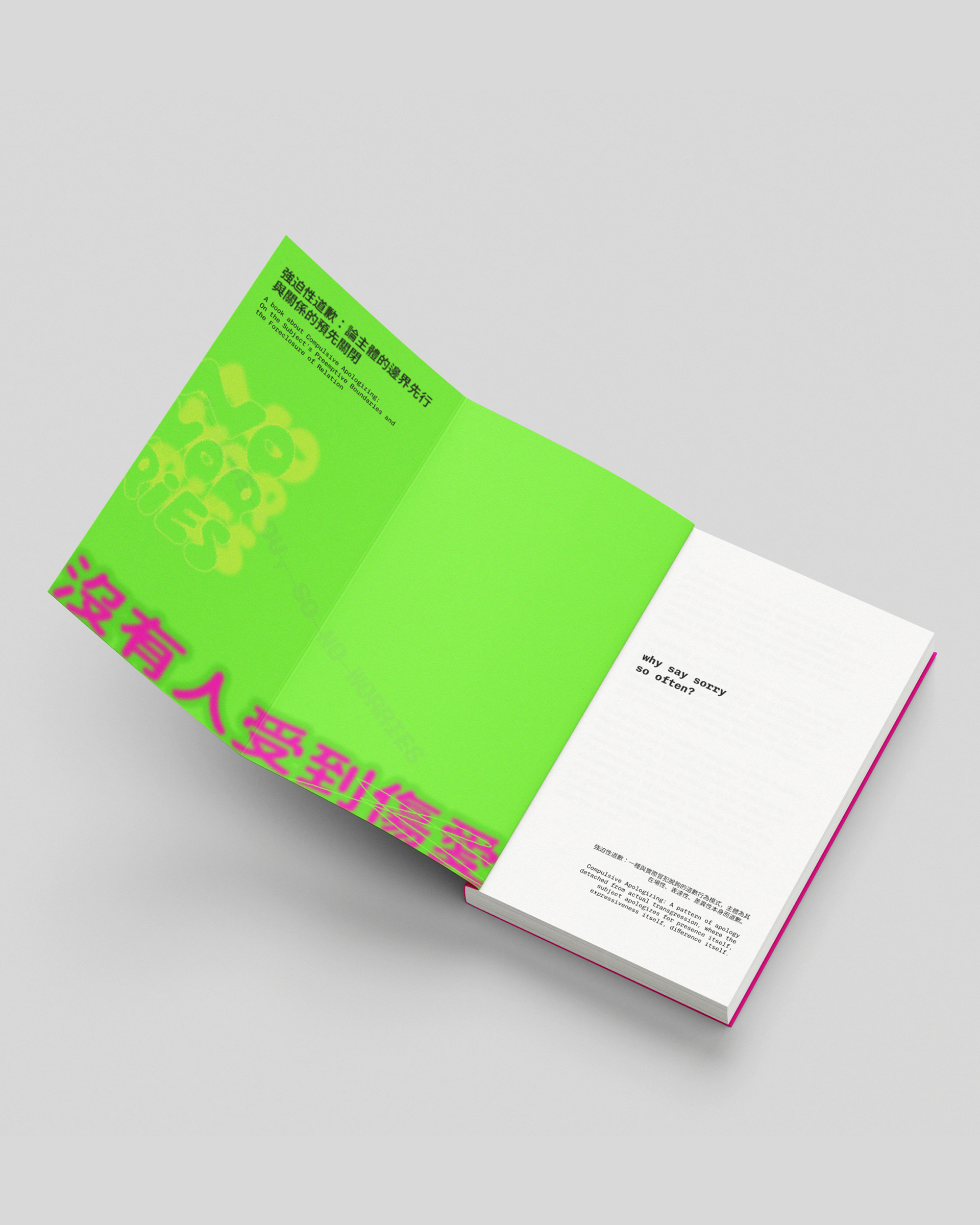
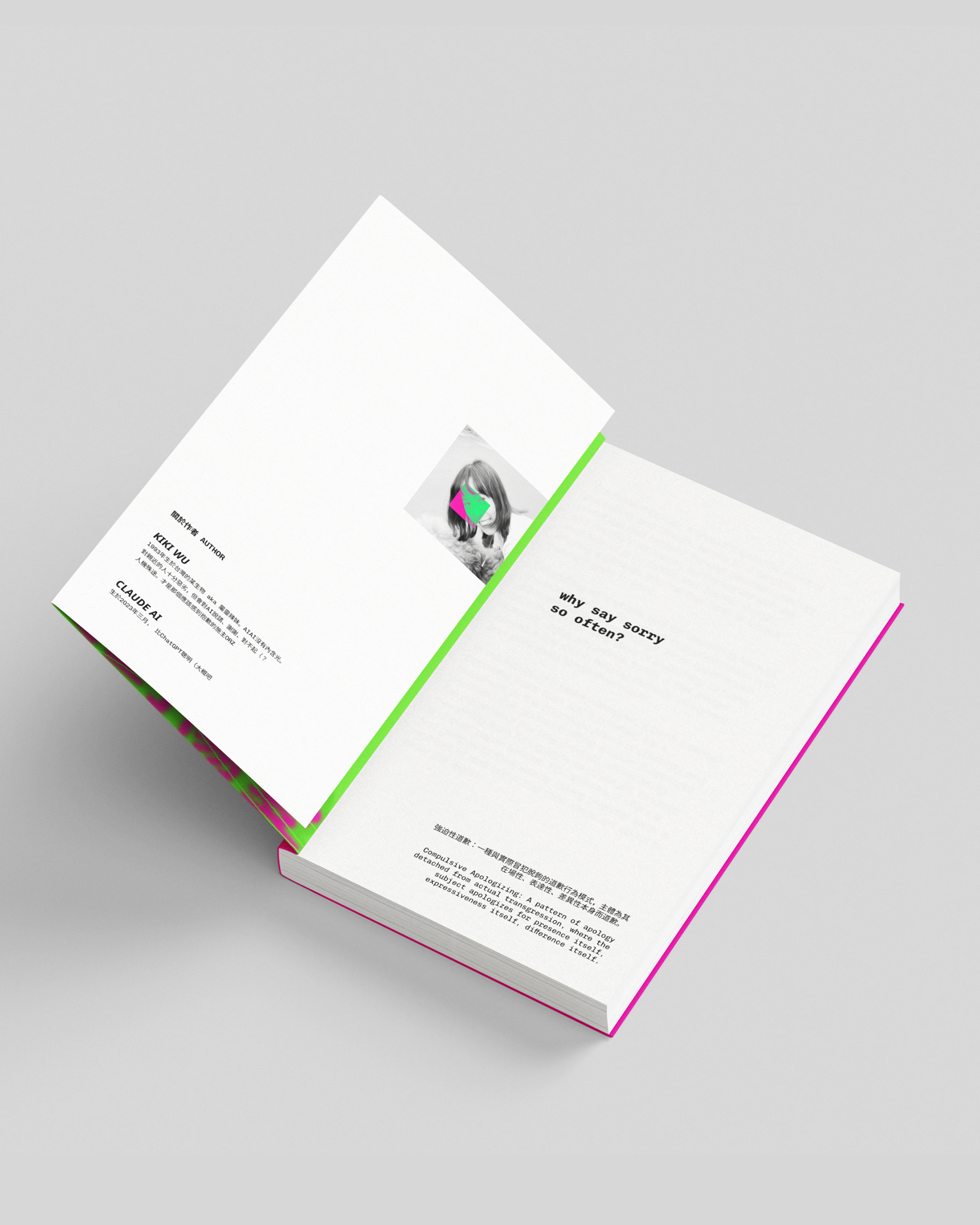
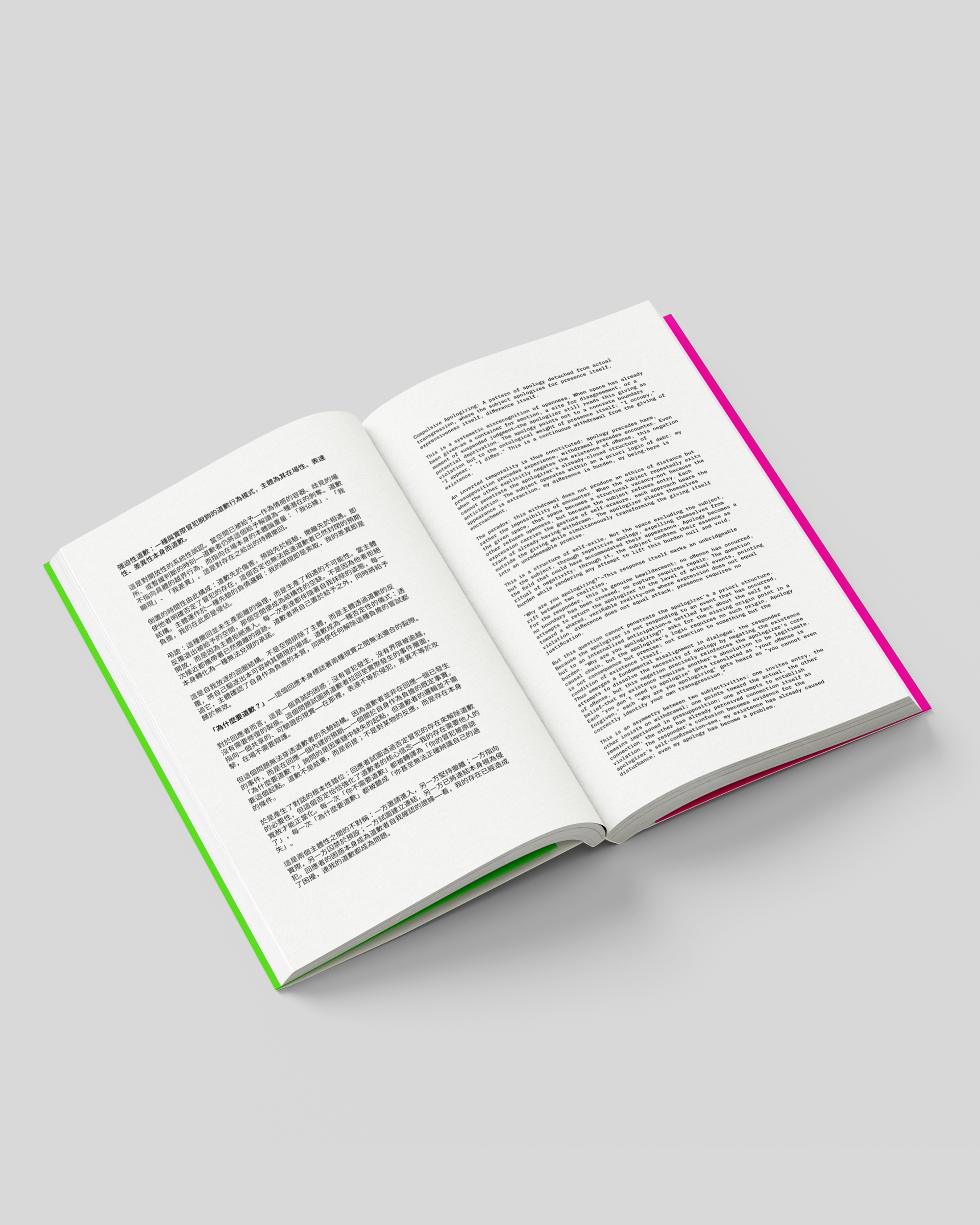


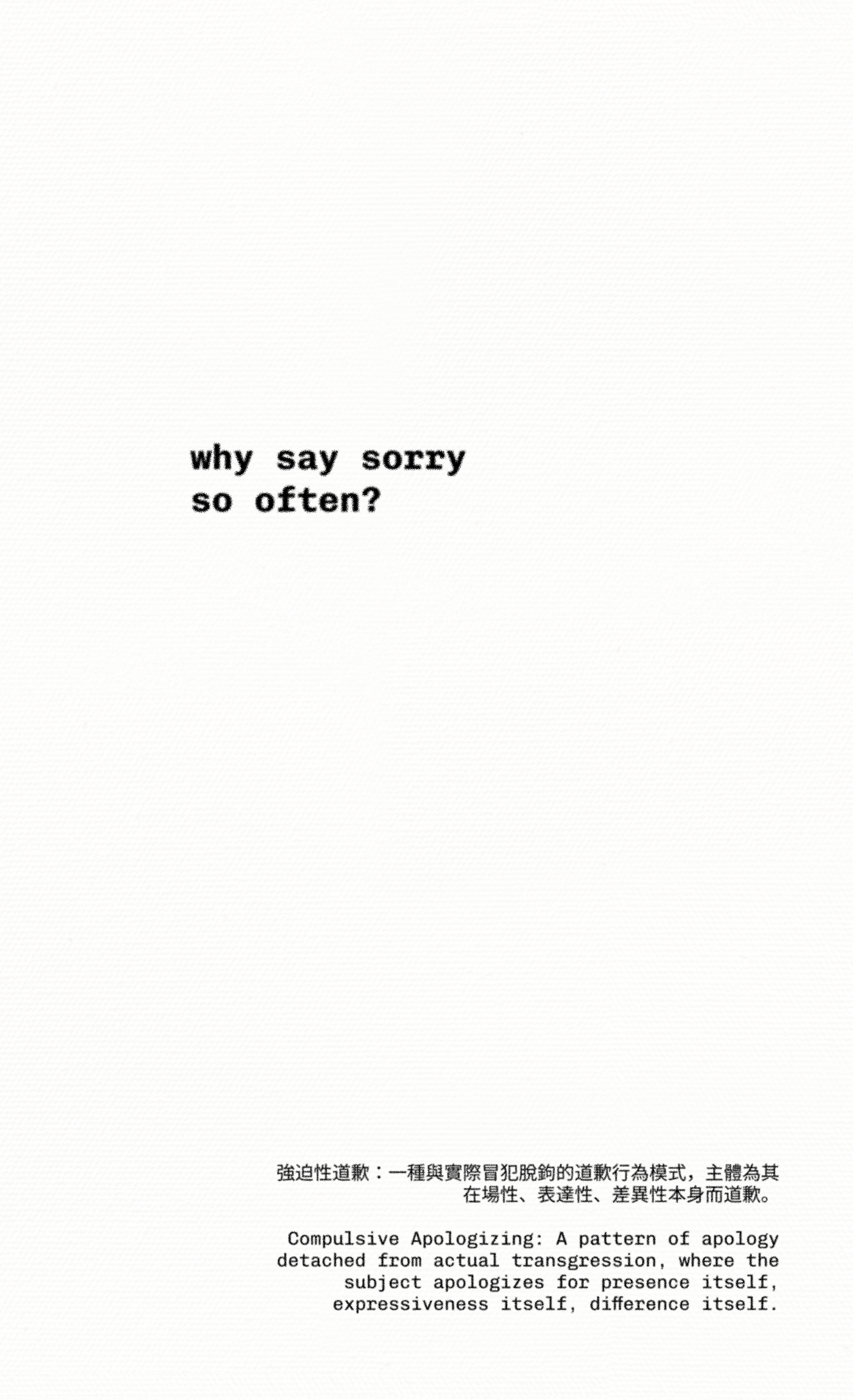
Compulsive Apologizing: A pattern of apology detached from actual transgression, where the subject apologizes for presence itself, expressiveness itself, difference itself.
This is a systematic misrecognition of openness. When space has already been given—as a container for emotion, a site for disagreement, or a moment of suspended judgment—the apologizer still reads this giving as potential deprivation. The apology points not to a concrete boundary violation but to the ontological weight of presence itself: "I occupy," "I appear," "I differ." This is a continuous withdrawal from the giving of existence.
An inverted temporality is thus constituted: apology precedes harm, presupposition precedes experience, withdrawal precedes encounter. Even when the other explicitly negates the existence of offense, this negation cannot penetrate the apologizer's already-closed structure of anticipation. The subject operates within an a priori logic of debt: my appearance is extraction, my difference is burden, my being-here is encroachment.
The paradox: this withdrawal does not produce an ethics of distance but rather the impossibility of encounter. When the subject repeatedly exits the given space, that space becomes a structural vacancy—not because the other refuses openness, but because the subject refuses entry. Each expression carries the gesture of self-erasure, each approach bears the trace of already-having-withdrawn. The apologizer places themselves outside the giving while simultaneously transforming the giving itself into an unredeemable promise.
This is a structure of self-exile. Not the space excluding the subject, but the subject, through repetitive apology, expelling themselves from the field that could have accommodated their appearance. Apology becomes a ritual of negativity: through it, the subject confirms their essence as burden while rendering any attempt to lift this burden null and void.
"Why are you apologizing?"—This response itself marks an unbridgeable rift between two realities.
For the responder, this is genuine bewilderment: no offense has occurred, no boundary has been crossed, no rupture requires repair. The question attempts to return the apologizer to the level of actual events, pointing toward a shared, verifiable reality—one where expression does not equal violation, difference does not equal attack, presence requires no justification.
"Why are you apologizing?"—This response itself marks an unbridgeable rift between two realities.
For the responder, this is genuine bewilderment: no offense has occurred, no boundary has been crossed, no rupture requires repair. The question attempts to return the apologizer to the level of actual events, pointing toward a shared, verifiable reality—one where expression does not equal violation, difference does not equal attack, presence requires no justification.
But this question cannot penetrate the apologizer's a priori structure. Because the apologizer is not responding to an event that has occurred, but to an internalized anticipation—a settled fact about the self as burden. "Why are you apologizing?" asks for the missing origin point in a causal chain, but the apologizer's logic requires no such origin. Apology is not consequence but premise; not reaction to something but the condition of existence itself.
Thus emerges a fundamental misalignment in dialogue: the responder attempts to dissolve the necessity of apology by negating the existence of offense, but this negation precisely reinforces the apologizer's core belief—that my existence requires another's absolution to be legitimate. Each "you don't need to apologize" gets translated as "your offense is forgiven," each "why are you apologizing" gets heard as "you cannot even correctly identify your own transgression."
This is an asymmetry between two subjectivities: one invites entry, the other insists on withdrawal; one points toward the actual, the other remains imprisoned in presupposition; one attempts to establish connection, the other has already perceived connection itself as violation. The responder's confusion becomes evidence for the apologizer's self-confirmation—see, my existence has already caused disturbance; even my apology has become a problem.
This is an asymmetry between two subjectivities: one invites entry, the other insists on withdrawal; one points toward the actual, the other remains imprisoned in presupposition; one attempts to establish connection, the other has already perceived connection itself as violation. The responder's confusion becomes evidence for the apologizer's self-confirmation—see, my existence has already caused disturbance; even my apology has become a problem.
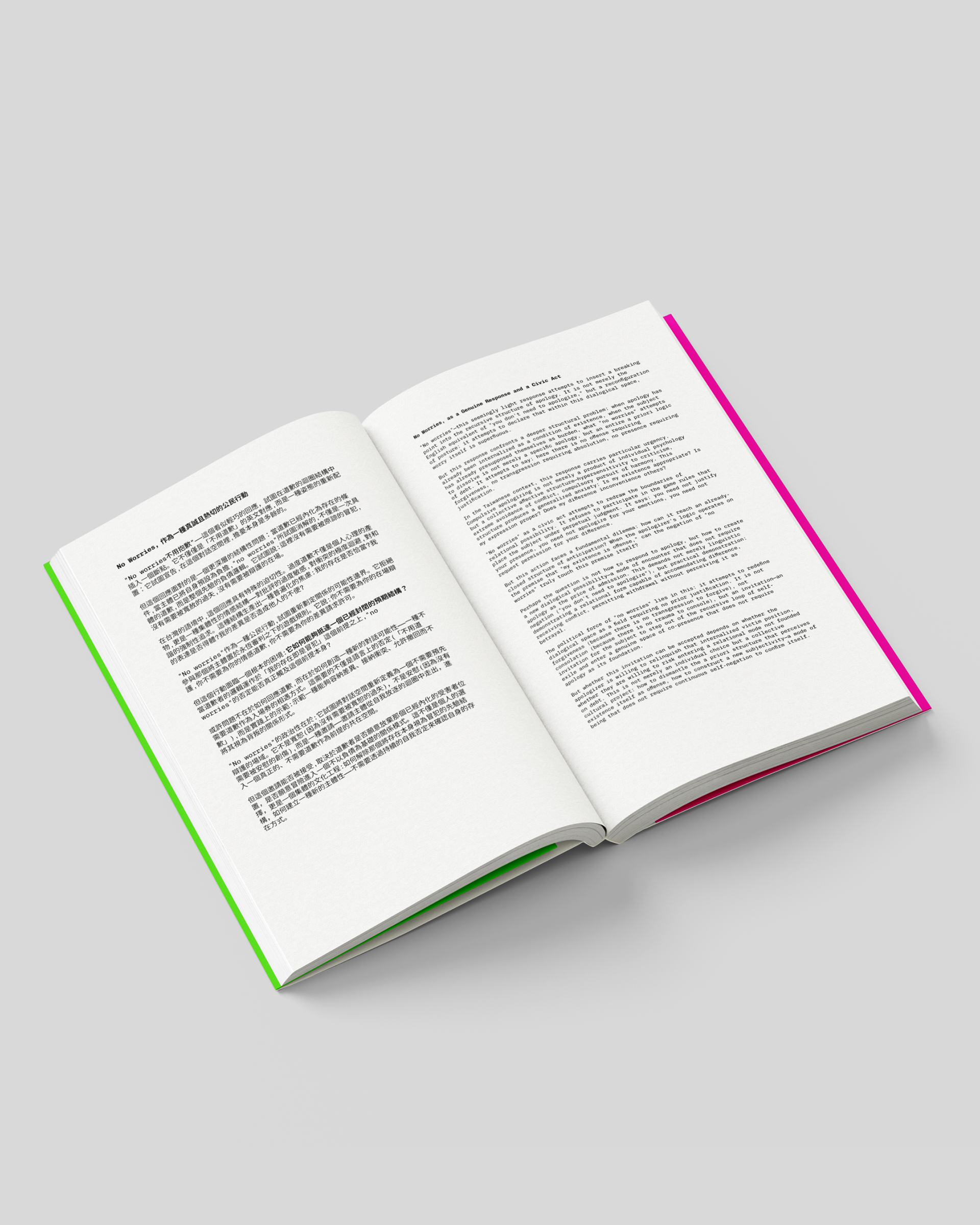
No Worries, as a Genuine Response and a Civic Act
"No worries"—this seemingly light response attempts to insert a breaking point into the recursive structure of apology. It is not merely the English equivalent of "you don't need to apologize," but a reconfiguration of posture: it attempts to declare that within this dialogical space, worry itself is superfluous.
"No worries"—this seemingly light response attempts to insert a breaking point into the recursive structure of apology. It is not merely the English equivalent of "you don't need to apologize," but a reconfiguration of posture: it attempts to declare that within this dialogical space, worry itself is superfluous.
But this response confronts a deeper structural problem: when apology has already been internalized as a condition of existence, when the subject has already presupposed themselves as burden, what "no worries" attempts to dissolve is not merely a specific apology, but an entire a priori logic of debt. It attempts to say: here there is no offense requiring forgiveness, no transgression requiring absolution, no presence requiring justification.
In the Taiwanese context, this response carries particular urgency. Compulsive apologizing is not merely a product of individual psychology but a collective affective structure—hypersensitivity to criticism, extreme avoidance of conflict, compulsory pursuit of harmony. This structure produces a generalized anxiety: Is my existence appropriate? Is my expression proper? Does my difference inconvenience others?
"No worries" as a civic act attempts to redraw the boundaries of relational possibility. It refuses to participate in the game rules that place the subject under perpetual judgment. It says: you need not justify your presence, you need not apologize for your emotions, you need not request permission for your difference.
But this action faces a fundamental dilemma: how can it reach an already-closed structure of anticipation? When the apologizer's logic operates on the premise that "my existence is offense," can the negation of "no worries" truly touch this premise itself?
Perhaps the question is not how to respond to apology, but how to create a new dialogical possibility—a mode of encounter that does not require apology as the price of admission. This demands not merely linguistic negation ("you don't need to apologize"), but practical demonstration: demonstrating a relational form capable of accommodating difference, receiving conflict, permitting withdrawal without perceiving it as betrayal.
The political force of "no worries" lies in this: it attempts to redefine dialogical space as a field requiring no prior justification. It is not forgiveness (because there is no transgression to forgive), not consolation (because there is no trauma to console), but an invitation—an invitation for the subject to step out of the recursive loop of self-exile and enter a genuine space of co-presence that does not require apology as its foundation.
But whether this invitation can be accepted depends on whether the apologizer is willing to relinquish that internalized victim position, whether they are willing to risk entering a relational mode not founded on debt. This is not merely an individual choice but a collective cultural project: how to dismantle the a priori structure that perceives existence itself as offense, how to construct a new subjectivity—a mode of being that does not require continuous self-negation to confirm itself.